


Hip Pain Relief — Burnaby BC
Hip Pain That Won't Resolve? Your Pelvis and Lumbar Spine May Be the Key.
The hip joint and lumbar spine are mechanically inseparable. Persistent hip pain — whether from the joint itself or the sacroiliac joint beside it — is almost always connected to how your pelvis and lower back are aligned. At Adapt Spine Centre in Burnaby, we assess and correct the spinal root of your hip dysfunction.
SI Joint
Sacroiliac dysfunction is responsible for up to 25% of all low back and hip pain
Gonstead
Specific pelvic and sacral analysis before every adjustment
No Referral
Book directly from Burnaby Heights, North Burnaby, and beyond
The Hip-Spine Connection
Why Hip Pain Is Rarely Just a Hip Problem
The hip joint sits at the intersection of the pelvis, lumbar spine, and lower extremity — meaning its mechanics are intimately linked to every structure above and below it. The sacroiliac (SI) joints connect the sacrum to the ilium on each side of the pelvis, and when these joints become dysfunctional — through misalignment, inflammation, or asymmetric loading — the result is a deep, aching pain in the buttock and hip that is commonly mistaken for hip joint pathology.
Lumbar vertebral misalignment creates pelvic tilt and rotational asymmetry that alters the load distribution across the hip joints. This uneven loading accelerates cartilage wear in the hip, drives the tight hip flexors and glutes that cause groin and buttock pain, and often creates a leg-length discrepancy (true or functional) that ripples downward through the knee and ankle.
At Adapt Spine Centre in Burnaby, our Gonstead system evaluates the full lumbopelvic picture — measuring pelvic tilt, sacral rotation, lumbar disc health, and SI joint mechanics — before making any targeted corrections. Many patients who have been told their hip pain is "just arthritis" or "a tight hip flexor" find that a structural lumbopelvic correction produces relief that stretching and physiotherapy alone never achieved.
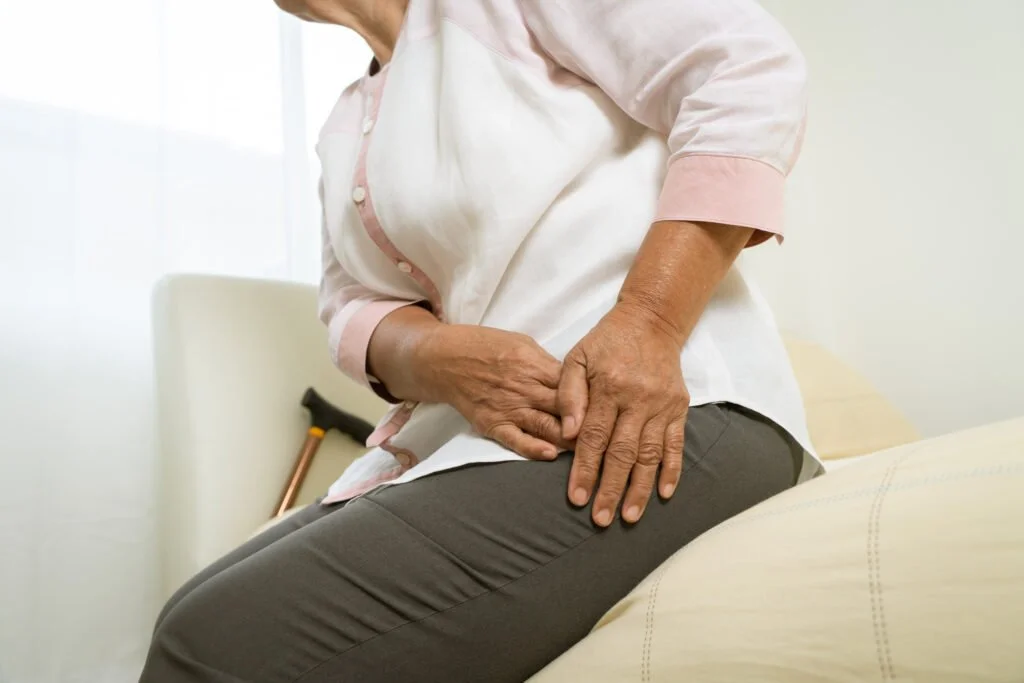
Deep buttock or groin pain on one or both sides — often worsening with prolonged sitting or standing
Pain when getting up from a chair or climbing stairs
Hip clicking or catching with movement
One hip higher than the other — pelvic tilt visible in standing posture
Pain that refers into the thigh or knee without a clear knee injury
Common Causes
What's Really Driving Your Hip Pain
Sacroiliac joint dysfunction
The SI joints bear the full weight transfer between the spine and legs. Misalignment here causes deep buttock pain, pelvic instability, and altered hip mechanics — and is frequently missed on standard MRI and X-ray.
Hip osteoarthritis
Cartilage degeneration in the hip joint itself — significantly influenced by the mechanical environment created by lumbar and pelvic alignment. Correcting spinal mechanics reduces the compressive forces driving OA progression.
Pregnancy-related pelvic changes
Relaxin loosens SI joint ligaments during pregnancy, creating pelvic instability and hip pain that often persists postpartum if the SI joints don't fully re-stabilize. Specific pelvic corrections address this directly.
Lumbar vertebral misalignment
L4/L5/S1 misalignment creates pelvic obliquity — a tilt that puts asymmetric load on one hip. Over time this drives OA on the overloaded side and chronic hip flexor/glute tension on the underloaded side.
Piriformis syndrome
The piriformis muscle — deep in the buttock, running from the sacrum to the femur — tightens in response to sacral misalignment. When tight, it compresses the sciatic nerve, creating hip, buttock, and leg pain that mimics true sciatica.
Sports and impact injuries
Falls, running injuries, and contact sports create SI joint and lumbar injuries that generate persistent hip pain. Athletes from across Burnaby often arrive with hip pain that began after a specific incident and never fully resolved.

The Gonstead Approach to Hip Pain
Pelvic Precision — Correcting the Foundation of Your Hip Problem
The pelvis is the structural foundation of the spine. The Gonstead system's approach to pelvic analysis is one of its most distinctive features — measuring sacral angle, iliac rotation, and lumbar-pelvic alignment from weight-bearing X-rays to identify precisely which pelvic and lumbar structures require correction.
Full Lumbopelvic X-Ray Analysis
Weight-bearing AP and lateral X-rays allow us to measure pelvic obliquity, sacral angle, lumbar lordosis, and disc height across the entire lumbopelvic region — identifying the specific misalignments creating abnormal hip loading.
Sacral & Pelvic Corrections
Gonstead pelvic adjustments specifically address the SI joints, sacrum, and lumbar vertebrae driving your hip dysfunction. We adjust only the structures confirmed to be misaligned — leaving well-functioning segments alone.

Measured Outcomes
We track pelvic symmetry, leg length equalization, and pain distribution throughout your care plan with repeat assessments — so you can see objectively that your pelvis is re-aligning and your hip loading is normalizing.
Common Questions
Hip Pain FAQs
Can a chiropractor help with sacroiliac joint pain?
Yes — SI joint dysfunction is one of the conditions Gonstead chiropractic is particularly well-suited to address. The specific pelvic analysis tools of the Gonstead system — including AP pelvis X-rays and sacral motion assessment — allow us to identify exactly which SI joint is involved and in which direction it has misaligned, guiding a precise correction.
My doctor says my hip pain is arthritis — can chiropractic still help?
Often, yes. Even when hip OA is confirmed on imaging, the mechanical environment created by spinal and pelvic alignment significantly affects how much pain that arthritis generates. By reducing abnormal hip loading through lumbopelvic corrections, many patients with confirmed hip OA experience meaningful pain reduction and mobility improvement — even without any change in the arthritic joint itself.
Do I need a referral to see a chiropractor for hip pain in Burnaby?
No referral needed. We welcome new patients directly. If you have existing hip imaging (X-ray or MRI), please bring it — it gives us additional information alongside our own assessment. We see patients from across Burnaby, North Burnaby, Burnaby Heights, and East Vancouver.
Related Conditions

Hip Pain That Limits Your Life Has a Structural Root. Let's Find It.
Book your initial exam at Adapt Spine Centre in Burnaby. We'll assess your full lumbopelvic picture and give you a clear, honest plan for addressing the structural cause of your hip pain.
Located at 3961 Hastings Street #101, Burnaby BC · Open Mon–Sat · No referral required